Safeguarding
St Simon and St Jude C of E Primary School is committed to safeguarding and promoting the welfare of children and expects all staff and volunteers to share this commitment.
We have a number of policies and procedures in place that contribute to our safeguarding commitment, including our Child Protection / Safeguarding Policy.
Sometimes we may need to share information and work in partnership with other agencies when there are concerns about a child's welfare. We will ensure that our concerns about our pupils are discussed with his/her parents/carers first unless we have reason to believe that such a move would be contrary to the child's welfare.
There are safeguarding leads:
Designated Safeguarding Lead: Mrs Karen Harvey
Designated Safeguarding Deputy: Mrs Bullock
Designated Safeguarding Deputy: Mrs Simmons
Designated Safeguarding Deputy: Mrs Braidley
Out of Hours Safeguarding
Please be aware that during the school holidays and times when the school is closed, you are still able to inform us of any child protection concerns you may have on the following email addresses: safeguarding@sssj.risemat.co.uk
If you have an immediate concern and feel that a child is at risk of significant harm or danger, please contact the police.
You can also contact Leicestershire County Council Children's Social Care and Early Help, who will be able to offer further advice and guidance. They can be contacted on 0116 305 8727 and more information is available at Help for children and families | Leicestershire County Council.
Please see the links below of national services that may be able to support you during the school holidays.
YoungMinds | Mental Health Charity For Children And Young People | YoungMinds
Shelter - The housing and homelessness charity - Shelter England
Getting help for domestic violence and abuse - NHS
The Prevent Duty
What is the Prevent duty?
- Prevent is a government strategy designed to stop people becoming terrorists or supporting terrorist or extremist causes.
- The Prevent duty covers all types of terrorism and extremism, including the extreme right wing, violent Islamist groups and other causes.
How does the Prevent duty apply to schools?
- From July 2015 all schools (as well as other organisations) have a duty to safeguard children from radicalisation and extremism.
- This means we have a responsibility to protect children from extremist and violent views the same way we protect them from any other harm.
- Importantly, we can provide a safe place for pupils to discuss these issues, at an appropriate level, so they better understand how to protect themselves.
What does this mean in practice at St Simon and St Jude's?
Many of the things we already do in school to help children become positive, happy members of society also contribute to the Prevent duty. These include:
- - A strong focus on celebrating diversity and exploring other cultures and religions
- - Focusing on core values.
- - Challenging prejudices and racist comments.
- - Developing critical thinking skills and a strong, positive self-identity.
- - Promoting the spiritual, moral, social and cultural development of pupils, as well as British values such as democracy.
- - We will also protect children from the risk of radicalisation, for example by using filters on the internet to make sure they can’t access extremist and terrorist material, or by vetting visitors who come into school to work with pupils.
Different schools will carry out the Prevent duty in different ways, depending on the age of the children and the needs of the community.
Isn't my child too young to learn about extremism?
The Prevent duty is not just about discussing extremism itself, which may not be appropriate for younger children. It is also about teaching children values such as tolerance and mutual respect. This is what we will focus on at our school.
The school will make sure any discussions are suitable for the age and maturity of the children involved.
Is extremism really a risk in our area?
Extremism can take many forms, including political, religious and misogynistic extremism. Some of these may be a bigger threat in our area than others. Our Safeguarding Team ensure they are up-to-date on threats in our local area which is monitored through our school context.
We will endeavour to give children the skills to protect them from any extremist views they may encounter, now or later in their lives.
Further information
Contact the school - If you have any questions or concerns about the Prevent duty and what it means for your child, please do not hesitate to contact the school.
See our policies - You will find more details about radicalisation in our safeguarding policy, available on our website. We also have information about spiritual, moral, social and cultural development and British values. The school has a risk assessment for Prevent which may be made available on request.
Key Terms
Extremism – vocal or active opposition to fundamental British values
Ideology – a set of beliefs
Terrorism – a violent action against people or property, designed to create fear and advance a political, religious or ideological cause
Radicalisation – the process by which a person comes to support extremism and terrorism
External Sources
The following sources may also be useful for further information:
Domestic Violence and Sexual Abuse Support
Some national agencies have reported a significant increase in domestic abuse associated with the current pandemic, and this follows the experience of other countries. We want to do everything we can to reduce the harm this can cause.
You can get expert support from Freeva by clicking Free from Violence & Abuse | Support & Services | Freeva or calling their helpline on 0808 802 0028.
If you require any support, please contact any of our school DSLs on the school number (01455 842138) or by email office@sssj.risemat.co.uk.
Please look at the flyer below for details of helplines and support resources. No one should suffer in silence – we are here for you.
Finally, a reminder that anyone can contact Leicestershire County Council First Response if they have any concerns about a child’s safety and wellbeing. The number is 0116 305 0005.
Family Help is the new name for the Children and Family Wellbeing Service. Family Help provides targeted early help to families – and when needed, Child in Need services.
We provide early help services to families, where they're experiencing difficulties that can't be supported by universal services such as schools or GPs alone.
We provide a wide range of support for you and your family (see our pages below). Sometimes, if needs are more complicated, we'll work with social workers to make sure your needs are being met. We'll always talk to you about this first. Call 0116 305 8727
Help for children and families | Leicestershire County Council
Helpful Links
Please look at the links below for advice and support to help with parenting school children. Advice ranging from health and social issues, to parenting advice and help with what to do to help your child through school and after school.
Link to our School Nurse Information:
https://stsimonandstjude.web11.juniperwebsites.co.uk/school-nurse-2
Other helpful websites:
NSPCC Pants
Talk PANTS is a simple conversation to help keep your child safe from sexual abuse.
Childline
A free, private and confidential service where children can talk about anything.
Anti-bullying Alliance
A wealth of resources and support promoting anti-bullying.
BBC Own It
A website full of games, videos and resources to promote positive emotional wellbeing.
Young Minds
A website to support parents and carers with their child’s behaviour and mental health.
NWG Network
Information for parents and carers and child sexual exploitation
HappyMaps
A website with a wealth of resources to support children’s behaviour and mental health
Relate – Parenting teenagers
Parenting teenagers can be challenging and many parents find it hard to adapt to changes in their child’s behaviour as they grow up. Here you’ll find lots of practical advice on how to deal with common teen issues.
Family Lives – Parenting teenagers
Parenting teenagers can be difficult but teens still need you. Read advice pages on what teenagers need from their parents and how to improve the parent teenager relationship.
Mumsnet – Parenting teenagers
Parenting teenagers can be the hardest job in the world. Here is some Mumsnet advice about the thrills and spills of parenting teenagers.
NHS – coping with your teenager
Information and advice for parents on dealing with their teenager, including what changes children go through in their teenage years, and how to deal with challenging teenage behaviour.
NSPCC – Drugs and Alcohol
Lots of parents are concerned about underage drinking and drug taking. Find out how you can keep your child safe and aware of the risks.
Careers advice for parents
Careers Advice for UK parents, young people, school leavers, A Level students, teenagers. Independent, informative & accurate.
Careers helpline for teenagers
Call the National Careers Service helpline for information and advice about jobs, careers and training if you’re 13 or older.
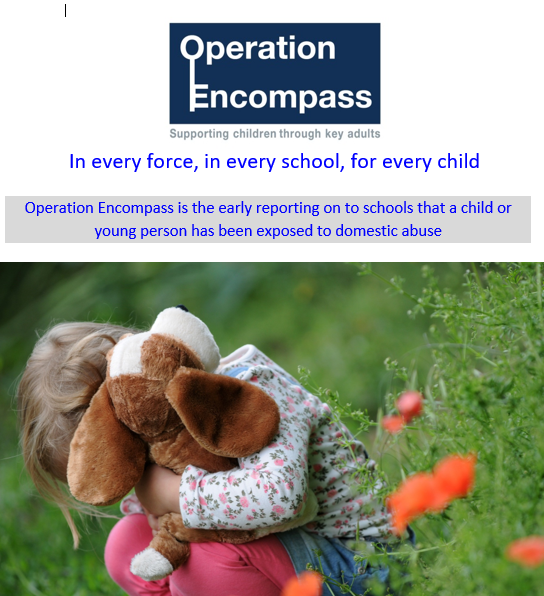
Operation Encompass
What is Operation Encompass?
In every force: Our aim is to ensure that schools have timely information about all police-attended incidents of domestic abuse, no matter where in the world the child lives.
In every school: Our aim is to enable staff in every school to understand how to support children who are experiencing domestic abuse, no matter where in the world the child lives.
For every child: Our aim is to ensure all children experiencing domestic abuse receive timely support in their school, no matter where in the world the child lives.
Operation Encompass is a police, local authority and education early information safeguarding partnership enabling schools to offer immediate support to children experiencing domestic abuse.
Operation Encompass ensures that there is a simple telephone call or notification to a school's trained Designated Safeguarding Lead (known as key adult) prior to the start of the next school day after an incident of police-attended domestic abuse where there are children related to either of the adult parties involved.
Information is shared with a school's key adult (DSL) prior to the start of the next school day after officers have attended a domestic abuse incident. This sharing of information enables appropriate support to be given, dependent upon the needs and wishes of the child.
Children are negatively impacted by experiencing domestic abuse and, without early intervention and support, this negative impact can last through a child's life course. Domestic abuse can impact upon social, psychological, physical, emotional and behavioural outcomes with an often negative impact upon a child's academic success. Experiencing domestic abuse has been identified as an Adverse Childhood Experience.
Operation Encompass aims, by directly connecting police and schools, to secure better outcomes for children, to enable schools to better understand the impact living with domestic abuse has upon children, to help schools to better understand a child's lived experience and to therefore be able to support and nurture each child, making a child's day better and giving them a better tomorrow.
Our aim is to have Operation Encompass in every force, in every school, for every child, no matter where they live. It is simply every child's right.